
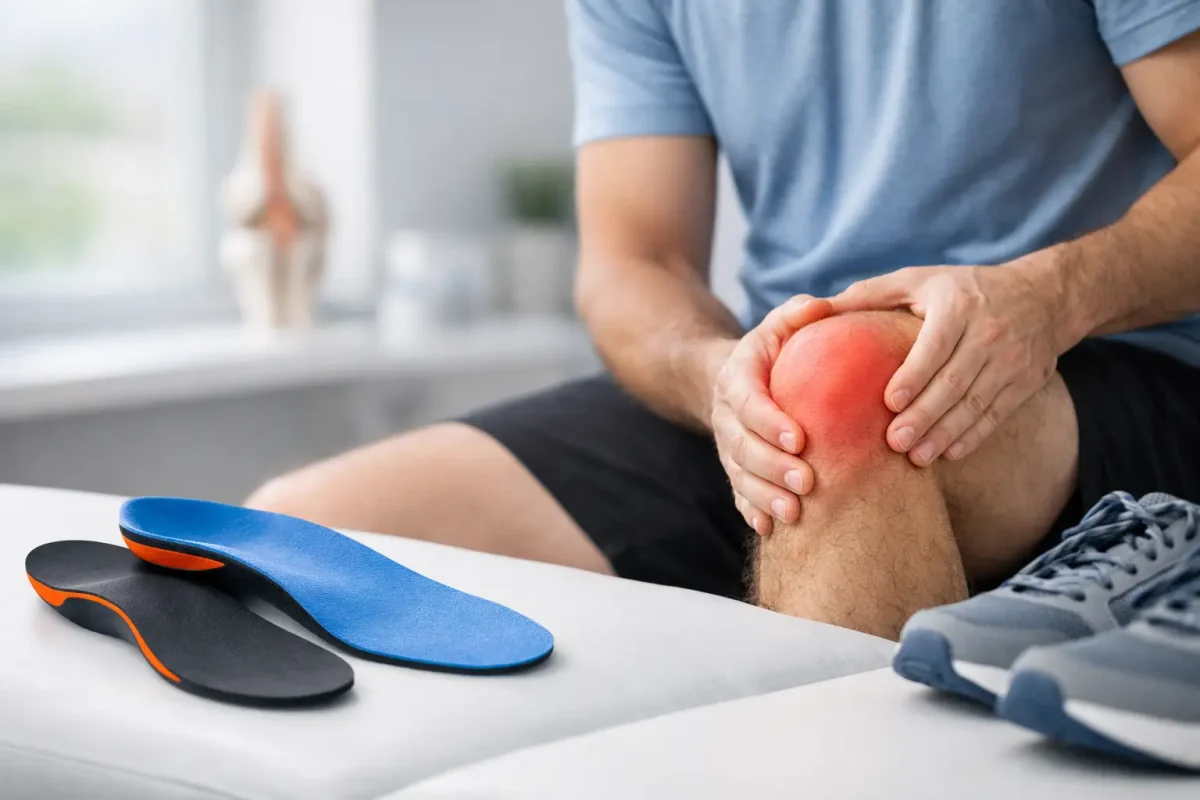
Knee pain can make a short walk to the shops, a full shift on your feet or a Saturday run feel far harder than it should. If you have noticed that your knee pain changes with different shoes, surfaces or activity levels, it is reasonable to ask: can orthotics help knee pain? For many people, the answer is yes – but only when the orthotic addresses a movement pattern that is contributing to the load on the knee.
Orthotics are not a one-size-fits-all cure, and they cannot repair every knee injury. They can, however, be a valuable part of a treatment plan by improving how the foot and lower limb work together with every step. At Comfort Feet Podiatry Group, we assess the whole chain of movement, from the way your foot meets the ground through to your ankle, calf, knee, hip and walking or running technique.
How orthotics may help knee pain
Your feet are the base of your lower-limb movement. When they roll in excessively, remain too rigid, or do not provide a stable platform as you walk or run, the shin can rotate in a way that changes the forces travelling through the knee. This does not mean every flat foot causes knee pain, or that a high arch is automatically a problem. It means the way your foot functions may matter when it is combined with your footwear, workload, muscle strength and previous injuries.
Orthotics sit inside your shoes to support, cushion or guide foot movement. A well-designed device may help distribute pressure more effectively and reduce repeated strain on structures around the knee. For someone who spends long days on concrete floors, this can make work more manageable. For a runner, it may help improve comfort while they rebuild training volume after an overuse injury.
The goal is not to force your foot into a perfectly still position. Healthy movement needs some flexibility. Rather, orthotics aim to provide the right degree of support and control for your body, activity and symptoms.
Conditions where foot mechanics can play a role
Orthotics may be considered for knee pain associated with patellofemoral pain, often felt around or behind the kneecap, particularly during stairs, squats, running or prolonged sitting. They can also be useful for some people with knee osteoarthritis, especially where walking mechanics and uneven loading are aggravating symptoms.
Iliotibial band-related pain, shin pain that travels towards the knee, and knee discomfort following an ankle or foot injury can also warrant a lower-limb biomechanical assessment. In these cases, an orthotic is usually only one component of care. Strength, mobility, training load and footwear often need attention too.
When orthotics are less likely to be the full answer
Knee pain has many possible causes. A torn ligament, meniscus injury, significant arthritis flare, tendon injury, hip weakness, lower-back referral or a sudden impact injury will not be solved simply by changing an insole. Even when foot mechanics contribute, an orthotic without rehabilitation may offer only partial or temporary relief.
This is why buying a generic insert and hoping for the best can be disappointing. Over-the-counter options can provide helpful cushioning or mild arch support for some people, particularly as a short-term trial. But they are made for an average foot shape and do not account for your knee position, gait, sport, occupation, injury history or footwear.
Custom orthotics are not automatically better for everyone either. Their value depends on whether there is a clear clinical reason to use them and whether their design matches the problem being treated. An unnecessarily rigid device can feel uncomfortable, alter your gait in an unhelpful way or simply sit unused in the bottom of the wardrobe.
Can orthotics help knee pain from running?
They can, particularly where a runner has a recurring pattern of pain linked to foot control, shoe wear or a rapid increase in distance, hills or speed work. But runners should be wary of viewing orthotics as permission to train through pain.
A sound plan looks at how much you are running, your cadence and technique where relevant, calf and hip strength, ankle range of motion, recovery, and whether your shoes suit your foot and running demands. Orthotics may reduce an aggravating load while these factors are addressed. They should support your return to running, not replace a gradual return-to-sport programme.
The same principle applies to court sports, football, golf and gym training. The right support can improve comfort, but muscles and tendons still need the capacity to manage the demands placed on them.
What happens in a podiatry assessment?
A useful assessment starts with your story. Your podiatrist will ask where the knee pain is located, when it began, what brings it on, whether it swells or gives way, and how it affects work, sleep, exercise and family life. Your footwear, medical history and previous injuries all matter.
The physical assessment may include checking foot posture, joint movement, calf flexibility, muscle function, balance and areas of tenderness. Walking and running patterns can then be observed to identify whether the foot, ankle and knee are moving in a way that could be increasing stress.
At a clinic with 3D biomechanics analysis, this assessment can provide a more detailed view of how your feet load and move. That information helps guide decisions about orthotic shape, materials and support levels where orthotics are appropriate. Softer cushioning may suit one person, while another may need more targeted control or an orthotic designed specifically for work boots, school shoes or sports footwear.
Orthotics work best as part of a treatment plan
The most effective knee pain care is rarely about one product. If your assessment identifies that orthotics may help, your treatment plan may also include targeted exercises to improve hip, calf, foot or knee strength; mobility work; footwear guidance; and a sensible plan for returning to activity.
Hands-on treatment may be appropriate in some cases, alongside neuromuscular rehabilitation to improve movement control. If pain is linked to a workplace injury, transport injury or a longer-term disability, care can also be planned around the practical requirements of your WorkSafe Victoria, TAC, NDIS or DVA pathway.
Your orthotics should be reviewed after you begin using them. It can take time for your body to adapt, and small adjustments can make a meaningful difference. You should not have to tolerate persistent rubbing, numbness, increased pain or a device that makes it harder to walk normally.
Signs your knee pain needs prompt assessment
Do not rely on orthotics alone if your knee is severely swollen, hot or red, locks in position, repeatedly gives way, cannot bear weight, or became painful after a significant fall, twist or collision. Seek timely medical assessment if you have fever, calf swelling, unexplained weight loss, night pain or worsening symptoms.
For less urgent but persistent pain, early assessment can prevent a small movement issue from becoming a longer interruption to the activities you enjoy. The sooner you understand what is loading your knee, the easier it is to make practical changes with confidence.
Knee pain should not dictate how far you walk, whether you play with the kids or whether you can return to the sport that keeps you feeling like yourself. A thorough lower-limb assessment can show whether orthotics have a genuine role in your recovery and create a clear path back towards comfortable, active movement.