
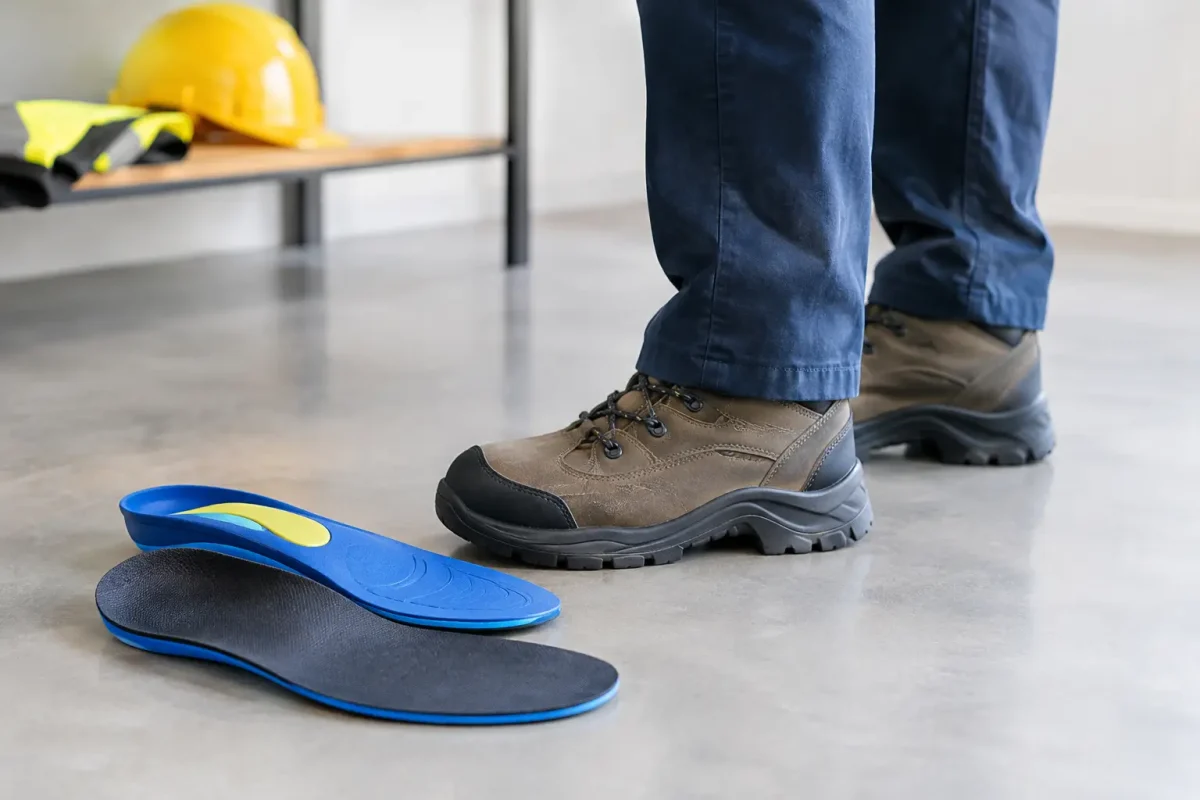
A long shift on concrete can make even a good pair of work shoes feel unforgiving. By the time you clock off, aching heels, tired arches, burning forefeet and tight calves can turn the walk to the car into another task. The best insoles for standing workers can reduce the load on your feet, but the right choice depends on how you stand, what shoes you wear and where your pain begins.
An insole is not simply a soft layer underfoot. A well-matched insole can improve pressure distribution, support the foot’s position and reduce strain travelling up through the ankles, calves, knees and lower back. The wrong one, however, can crowd a safety boot, aggravate a high arch or mask a problem that needs proper treatment.
Why standing all day can cause pain
Standing work places repeated, low-level stress through the lower limbs. Unlike walking, where the feet regularly change position and load, standing can keep the same tissues working for hours. Hard floors, limited breaks, poor shoe fit and heavy lifting can add to the problem.
Retail staff, hospitality workers, nurses, teachers, warehouse teams, tradies and factory workers often notice heel pain first. This may be related to plantar fasciitis, where the thick band of tissue under the foot becomes irritated. Others develop pain beneath the ball of the foot, sore arches, swelling around the ankles or calf tightness.
Foot shape matters too. Flat feet may allow the arch to roll inwards excessively, placing extra demand on the plantar fascia and lower-leg muscles. High arches can concentrate pressure on the heel and forefoot. Neither foot type is automatically a problem, but each may benefit from a different level and style of support.
Best insoles for standing workers: what to look for
The most comfortable insole in the shop is not always the most useful after an eight-hour shift. For standing workers, a good insole generally balances cushioning with structure. Very soft foam can feel pleasant at first but may compress quickly, offering little support by the end of the day.
Heel cushioning that does not collapse
A cushioned heel can reduce impact and ease pressure for people with sore heels or hard-floor exposure. Look for a material that retains its shape, rather than a thin gel pad that flattens within weeks. Heel cups can also help stabilise the heel and keep it better aligned during standing and walking.
If your heel pain is sharp with the first few steps in the morning, or persists after rest, it is worth seeking assessment rather than continually changing inserts. That pattern can be consistent with plantar fasciitis, but other causes of heel pain need to be ruled out.
Arch support matched to your foot
Arch support is often the feature workers search for, but higher is not necessarily better. The support should sit under your arch comfortably, without creating pressure or a hard lump. A person with a low, flexible arch may need firmer control through the midfoot, while someone with a high arch may need more cushioning and a gentler contour.
A supportive insole can reduce fatigue by helping spread load across the foot. It should not force your foot into an uncomfortable position. If an insole causes tingling, numbness, cramping or worsening pain, stop wearing it and have the fit checked.
Forefoot padding for ball-of-foot pain
Pain under the ball of the foot is common in jobs that involve standing at a counter, climbing ladders or pushing trolleys. An insole with forefoot cushioning can help, especially when combined with a shoe that has enough width and depth.
For some people, a targeted pad positioned just behind the painful area is more effective than extra foam across the entire forefoot. Placement matters. A pad in the wrong spot can increase pressure instead of relieving it, which is why persistent forefoot pain benefits from podiatry advice.
Firmness that suits your job and footwear
A hospitality worker moving quickly across a kitchen floor may need a different insole from a security guard standing in one area for long periods. Safety boots also have less spare room than some runners, particularly if they contain a fixed footbed.
Choose an insole that fits the shoe without lifting the heel out of the heel counter or squeezing the toes. In most cases, remove the existing removable liner before inserting a full-length insole. If the work shoe becomes tight, changing the boot or shoe fit may be more helpful than forcing in a thick insert.
Off-the-shelf or custom orthotics?
Off-the-shelf insoles can be a sensible starting point for mild fatigue, general hard-floor discomfort or short-term support while you improve footwear. They are readily available and may help when their shape suits your foot and their thickness suits your work shoe.
Custom orthotics are designed around your individual foot shape, movement pattern, symptoms and work demands. They may be recommended where pain is ongoing, one-sided, recurrent or linked with marked flat feet, high arches, previous injury or changes in knee and hip mechanics. They can also be useful for workers who have tried several retail insoles without lasting relief.
Custom does not mean excessively rigid. Modern orthotic design can combine control, cushioning and specific offloading where you need it. At Comfort Feet Podiatry Group, assessment may include 3D biomechanics analysis to understand how your feet and lower limbs are functioning under load, not just how they look while sitting on an examination chair.
Your insole will only work as well as your shoe
Insoles cannot fully compensate for footwear that is worn out, too narrow or poorly suited to the job. A supportive work shoe or safety boot needs a stable heel counter, enough toe room, secure fastening and a sole appropriate for the surfaces you work on.
Check your shoes regularly. A sole worn more on one side, a collapsed heel lining or a footbed that has permanently compressed can change how your foot is loaded. Rotating between two suitable pairs may help if your role allows it, giving shoes time to dry and recover between shifts.
Compression socks may assist some workers with lower-leg fatigue or swelling, but they are not a substitute for appropriate footwear or assessment. If swelling is sudden, significant, one-sided or associated with calf pain, seek urgent medical advice.
Simple changes that make standing easier
An insole works best as part of a broader plan. Small changes across the shift can reduce accumulated strain and help you stay comfortable at work.
- Change position frequently rather than locking your knees in one stance.
- Take short walking or calf-stretch breaks when your work environment permits.
- Use an anti-fatigue mat at a fixed workstation, if this is safe and practical.
- Replace worn work shoes before the support has visibly failed.
- Build calf, foot and hip strength if your lower limbs fatigue quickly.
These adjustments are especially valuable when pain is still mild. Waiting until every shift ends with limping can make recovery slower and may change the way you walk.
When foot pain needs a podiatry assessment
Do not rely on insoles alone if pain lasts more than a couple of weeks, repeatedly returns, wakes you at night or affects your ability to work. Assessment is also sensible if you have numbness, burning, pins and needles, visible swelling, a change in foot shape or pain following an injury.
A podiatrist can identify whether your discomfort is coming from the plantar fascia, tendons, joints, nerves or another part of the lower-limb chain. Treatment may involve footwear guidance, targeted exercises, hands-on therapy, custom orthotics or rehabilitation strategies to improve how you tolerate standing. For eligible patients, WorkSafe Victoria, TAC, DVA and NDIS pathways may also be available.
The goal is not to make your feet tolerate pain for longer. It is to help you finish work with enough comfort and confidence to keep moving through the rest of your life.