
That stiff, sore feeling at the back of your heel can make the first steps out of bed miserable, turn a run into a limp and make a full workday on your feet feel far longer than it should. If you are researching shockwave therapy Achilles tendinopathy treatment, the key question is not simply whether it can reduce pain. It is whether it is the right part of a plan to restore your tendon’s capacity for walking, work, sport and everyday life.
Achilles tendinopathy is rarely solved by resting until the pain settles, then returning straight to the same activity. The tendon needs the right amount of progressive loading, alongside a clear understanding of what caused it to become painful in the first place. Shockwave therapy can be a valuable tool in that process for some people, particularly when symptoms have persisted despite sensible early care.
What Achilles tendinopathy feels like
The Achilles tendon joins the calf muscles to the heel bone. It transfers force every time you walk uphill, climb stairs, push off at pace or jump. When the tendon is overloaded beyond its current capacity, it can become painful and less able to tolerate those demands.
Pain and stiffness are often most noticeable with the first few steps in the morning or after sitting. It may ease as you move, only to return later in the day or after exercise. Some people notice thickening, tenderness or swelling in the tendon. Others feel a more localised pain where the tendon attaches to the back of the heel, known as insertional Achilles tendinopathy.
This distinction matters. Mid-portion and insertional Achilles problems can respond differently to exercise, footwear changes and certain treatment techniques. A proper assessment should also rule out other causes of rear-foot pain, including bursitis, irritation from a heel spur, a partial tear or symptoms referred from elsewhere in the lower limb.
How shockwave therapy for Achilles tendinopathy works
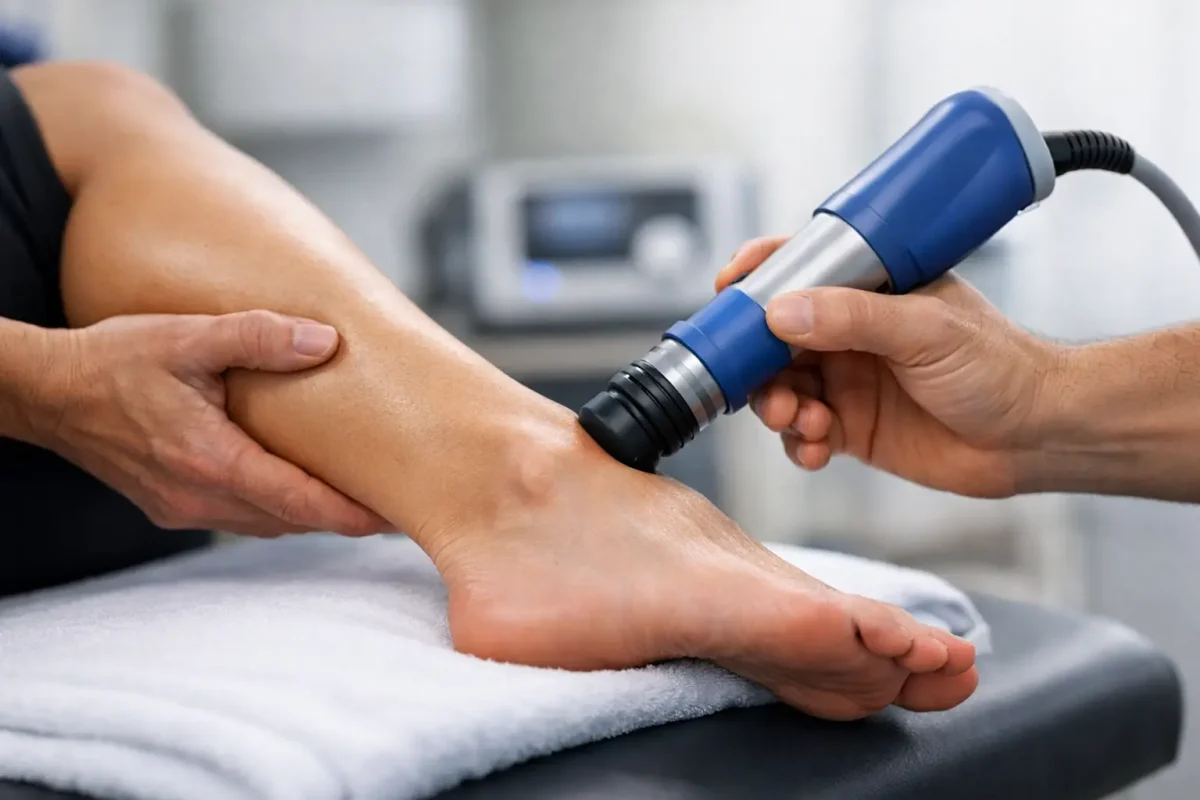
Shockwave therapy uses acoustic pressure waves delivered through a handheld device to the affected area. Despite the name, it is not an electric shock. The treatment aims to stimulate biological processes involved in tissue repair, improve local circulation and influence pain signalling. It may also help create a more favourable environment for the tendon to respond to a progressive rehabilitation program.
For persistent Achilles tendinopathy, shockwave therapy is generally considered an adjunct treatment. In plain terms, it works best as part of a broader plan, not as a stand-alone fix. Your podiatrist may combine it with calf-strengthening exercises, load management, footwear advice, manual treatment, orthotic assessment and biomechanical analysis where appropriate.
At Comfort Feet Podiatry Group, the focus is on the reason the Achilles has become overloaded, not just the tender spot. A sudden increase in running kilometres, hill work, hard playing surfaces, unsupportive shoes, tight or weak calf muscles, reduced ankle movement and changes in body weight can all contribute. For workers, the trigger may be a long stretch of shifts spent standing or walking on concrete rather than a sporting event.
What a session is like
Before treatment begins, your clinician will assess the tendon, your ankle and calf movement, footwear, walking pattern and activity demands. This helps determine whether shockwave therapy is suitable and where it should be applied.
During a session, gel is placed on the skin and the applicator is moved across targeted areas of the tendon and surrounding tissue. You may feel tapping or pulsing sensations. It can be uncomfortable over a sensitive tendon, but intensity is adjusted to a level you can tolerate. Sessions are usually brief, and a course is often spread over several weeks. The exact number and frequency depend on your presentation and response.
It is common to have some temporary soreness after treatment. That does not mean the tendon has been harmed, but it is a reason to follow the activity advice provided. Many people need to reduce high-impact loading for a short period while continuing carefully prescribed rehabilitation.
When shockwave therapy may be worth considering
Shockwave therapy may be considered when Achilles pain has continued for several months, is limiting activity and has not improved sufficiently with an appropriately structured loading program. It can be particularly useful for people who have tried to manage the problem themselves but remain caught in a cycle of pain settling and flaring each time they return to activity.
It is not automatically the first treatment for a recent flare-up. Early Achilles symptoms often respond well to adjusting training or work loads, addressing footwear and beginning suitable calf-strengthening exercises. Starting with the least invasive, most targeted treatment is usually sensible.
Suitability also depends on your health history. Your clinician needs to know about pregnancy, blood-thinning medication, bleeding disorders, reduced sensation, active infection, previous tendon rupture and any serious medical conditions. Shockwave therapy is not used over certain areas or in particular circumstances, so individual screening is essential.
A sudden snap, severe swelling, bruising, inability to push off or difficulty standing on tiptoes needs urgent assessment. These can be signs of an Achilles rupture or another significant injury, rather than routine tendinopathy.
Why rehabilitation still does the heavy lifting
Pain relief is welcome, but an Achilles tendon also needs to regain strength and tolerance. If you return to sprinting, netball, hiking or long shifts without rebuilding that capacity, the same overload can quickly return.
Rehabilitation usually begins at a level the tendon can tolerate. This may include isometric calf holds for pain modulation, then progressively heavier calf raises with the knee straight and bent. Both positions matter because they train different calf muscles that contribute to Achilles loading. As strength improves, the program may progress to single-leg work, faster movements, hopping and sport-specific drills.
The right dose is individual. A recreational runner training for a half-marathon has different requirements from a warehouse worker, a dancer or someone whose goal is simply to walk comfortably with their grandchildren. Pain during exercise is not always a sign to stop entirely, but it should be monitored. Your clinician can help you use symptoms over the following 24 hours to judge whether the tendon is coping with the load.
For insertional Achilles tendinopathy, some exercises may need modifying to avoid compressing the tendon against the heel bone. This is why copying a generic online program can be frustrating or counterproductive. What helps one person may aggravate another.
Footwear, orthotics and movement habits
A shoe with a very flat, flexible or worn-down heel can increase strain on an irritated Achilles. Temporarily choosing footwear with a slightly higher heel-to-toe drop may reduce symptoms for some people, while a short-term heel lift can occasionally be useful. These are management tools, not permanent substitutes for tendon strength.
If foot posture, ankle mobility or walking mechanics are adding to the tendon’s workload, custom orthotics or footwear modifications may be considered. A 3D biomechanics analysis can offer useful information in more complex or recurring cases. The goal is not to make every foot look the same, but to help the lower limb move and load more efficiently for your body and lifestyle.
What results can you realistically expect?
Improvement is usually gradual. Some people notice reduced pain after several shockwave sessions, while others first notice that they can complete their exercises or workday with fewer flare-ups. Tendons adapt slowly, so meaningful recovery often takes weeks to months rather than days.
Your outcome will depend on how long symptoms have been present, the severity and location of tendon change, your overall health, activity demands and consistency with rehabilitation. Shockwave therapy may reduce the barriers to loading the tendon, but it cannot replace the loading itself.
A good treatment plan also has checkpoints. If pain is not improving as expected, your podiatrist may reassess the diagnosis, modify your program or recommend further investigation. Persistent pain deserves a fresh clinical look, not endless repetition of the same treatment.
Your Achilles supports nearly every step you take. Getting it assessed early, then treating both the pain and the reason it developed, gives you the best chance of moving with confidence again – whether that means returning to the track, getting through a shift comfortably or simply enjoying a walk without thinking about your heel.