
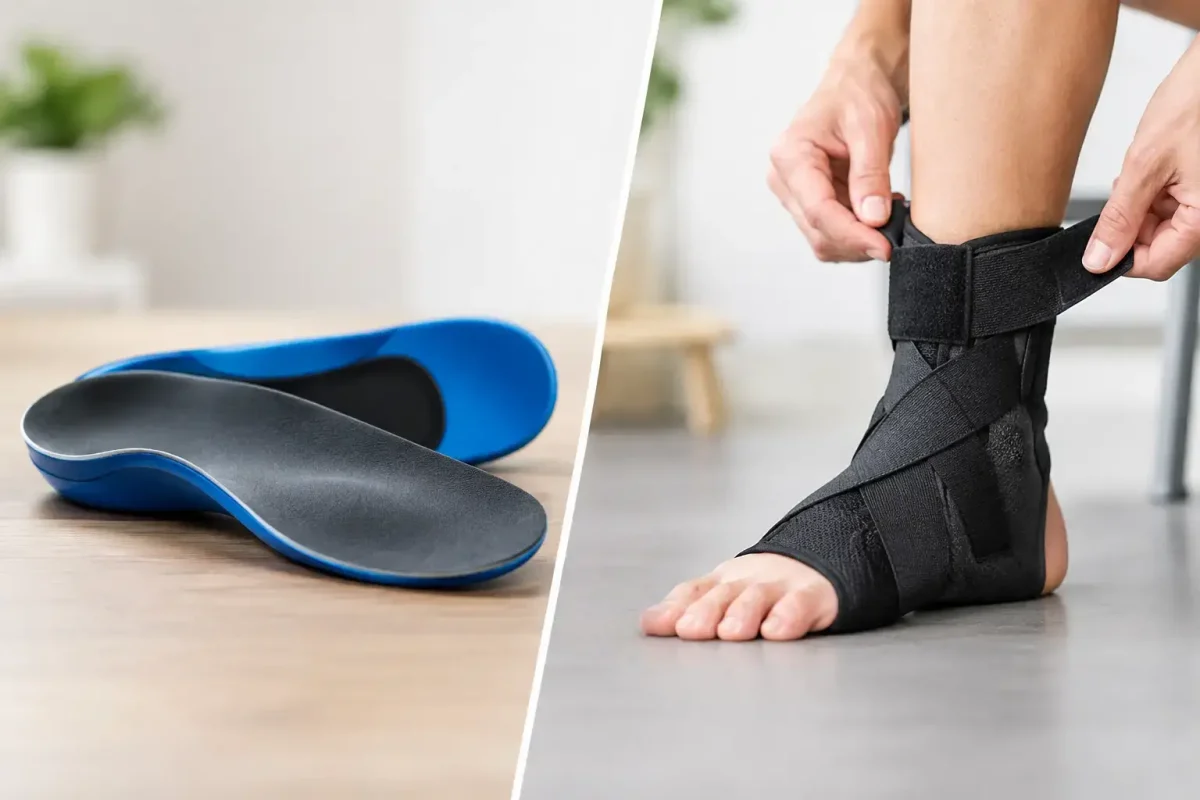
A rolled ankle during weekend sport, aching feet after a long shift, or a lingering sense that your ankle may give way can leave you asking the same practical question: orthotics versus ankle braces – which one will actually help? The answer depends on what is driving the pain or instability. These supports do different jobs, and choosing the wrong one can mask symptoms while the underlying issue continues.
An ankle brace is generally designed to support the ankle joint in the short term. Orthotics work from below, changing how forces travel through your feet, ankles, knees and legs with every step. For many people, the most effective plan may involve one, both, or neither – alongside targeted rehabilitation.
Orthotics versus ankle braces: the key difference
An ankle brace wraps around, laces over or straps onto the ankle to limit excessive movement. It is most often used after a sprain, during a return to sport, or when an ankle feels unstable. By providing external support, it can improve confidence and help protect healing ligaments from movements that may aggravate them.
Orthotics sit inside your shoes. They are designed to support, cushion or guide foot movement, depending on your foot shape, walking pattern, footwear and condition. A custom orthotic may help reduce the load that repeatedly reaches the ankle, particularly where flat feet, high arches, excessive pronation, leg alignment or poor shock absorption are contributing to symptoms.
Put simply, an ankle brace helps control the ankle from the outside. Orthotics influence the foundation beneath it. Neither is automatically better. The right choice starts with identifying why your ankle hurts, feels weak or keeps rolling.
When an ankle brace may be the better choice
A brace can be useful after an acute ankle sprain, especially in the early period when swelling, pain and ligament irritation make the joint feel unreliable. It can also be valuable during a gradual return to running, netball, football, tennis or other sports involving quick changes of direction.
For someone who has just stepped awkwardly off a kerb or landed on another player’s foot, a brace may offer short-term protection while the injury settles and rehabilitation begins. It can reduce the chance of the ankle moving into the same painful position again, particularly if there is a history of repeated sprains.
However, a brace is not a substitute for diagnosis or rehabilitation. Wearing one for months without addressing strength, balance and movement control may lead to ongoing dependence on external support. If your ankle repeatedly gives way, feels weak on uneven ground, remains swollen, or has not improved as expected, it deserves a thorough assessment.
Braces are usually temporary support
The best brace is one suited to the injury and activity. A simple compression sleeve may help with mild swelling and comfort, while a lace-up or semi-rigid brace may be more appropriate for instability. The fit matters too. A brace that is too loose will not offer meaningful support, while one that is too tight can cause pressure, numbness or altered circulation.
It should also fit comfortably in your shoes. If a brace changes your footwear fit so much that you walk differently, develop rubbing or avoid wearing supportive shoes, it may create a different problem.
When orthotics may be the better choice
Orthotics are often considered when ankle pain is linked to the way the foot works over time rather than a single recent injury. For example, feet that roll in excessively can place repeated strain on structures around the ankle. Very high arches may reduce natural shock absorption and concentrate pressure through the outside of the foot and ankle.
An orthotic can be particularly helpful where ankle symptoms occur alongside heel pain, plantar fasciitis, shin pain, forefoot pain, knee discomfort or fatigue after standing. These patterns can suggest that the issue is not isolated to the ankle joint.
For workers on their feet all day, an orthotic may reduce the cumulative stress of thousands of steps. For runners and active adults, it may improve comfort and loading through a training block. For older adults, it can support steadier, more comfortable mobility when foot mechanics and footwear are contributing to ankle strain.
Custom orthotics are not just “arch supports”
A custom orthotic is built around a clinical assessment, rather than being selected from a shelf because it feels comfortable for a few minutes. The prescription may include changes to heel control, cushioning, arch contour, forefoot support or accommodation for a painful area.
At Comfort Feet Podiatry Group, this process may include 3D biomechanics analysis to examine how your feet and lower limbs move during walking or sport-specific activity. That matters because two people with similar-looking feet can have very different movement patterns and treatment needs.
Not everyone requires custom orthotics. In some cases, footwear changes, an off-the-shelf device, calf strengthening, balance work or a short period of bracing may be enough. The goal is not to put every patient in an orthotic. It is to find the most direct path towards less pain and more confident movement.
Can you wear orthotics and an ankle brace together?
Yes, sometimes you can. This combination may be useful during the transition back to activity after an ankle sprain when there is both short-term instability and a longer-term foot mechanics issue. The brace provides protection around the joint, while the orthotic may help reduce the movement pattern that has been repeatedly loading it.
There are practical limits. Braces take up room in a shoe, and orthotics can change shoe volume and fit. Trying to force both into narrow work shoes, dress shoes or old runners can cause pressure points, toe numbness or heel rubbing. A podiatrist can check whether your footwear has enough depth, rearfoot stability and width for the support you need.
For sport, it is also worth considering whether the setup lets you move naturally. Too much restriction may affect agility, while too little support may leave you vulnerable to another sprain. The right balance changes as pain settles, strength improves and confidence returns.
What neither support can fix on its own
Supports can reduce symptoms and improve function, but they cannot repair every cause of ankle pain. Persistent ankle problems may involve ligament injury, tendon irritation, joint impingement, stress injury, arthritis, nerve irritation or referred pain from elsewhere in the lower limb.
They also cannot replace rehabilitation after an injury. The ankle relies on strength in the calf, foot and hip muscles, as well as the body’s ability to sense joint position and react quickly when you lose balance. Neuromuscular rehabilitation can rebuild these skills through exercises tailored to your injury, work demands and sport.
If you have tried a brace or orthotic and symptoms remain unchanged, do not assume you simply need a firmer version. Ongoing pain is useful information. It may mean the diagnosis, load management, footwear or rehabilitation plan needs to be reconsidered.
Signs you should arrange an assessment
Seek professional assessment promptly if you cannot take four steps after an injury, have marked swelling or bruising, notice deformity, experience numbness, or have severe pain over a bone. These signs may require more urgent investigation.
A podiatry assessment is also worthwhile if ankle pain lasts longer than a few weeks, your ankle repeatedly rolls, you avoid exercise because you do not trust the joint, or pain is affecting work and family life. Recurrent sprains are common, but they should not be accepted as normal.
A detailed assessment looks beyond the painful spot. It can consider your injury history, footwear, training volume, work surface, joint mobility, muscle strength and walking mechanics. From there, treatment may include bracing, custom orthotics, footwear advice, hands-on therapy, therapeutic ultrasound, exercise rehabilitation or referral for imaging where appropriate.
The most useful support is the one that helps you move forward without ignoring the reason you needed it. If your ankle is stopping you from walking confidently, working comfortably or getting back to the sport you enjoy, a clear assessment can turn trial-and-error into a plan for healthier movement.