
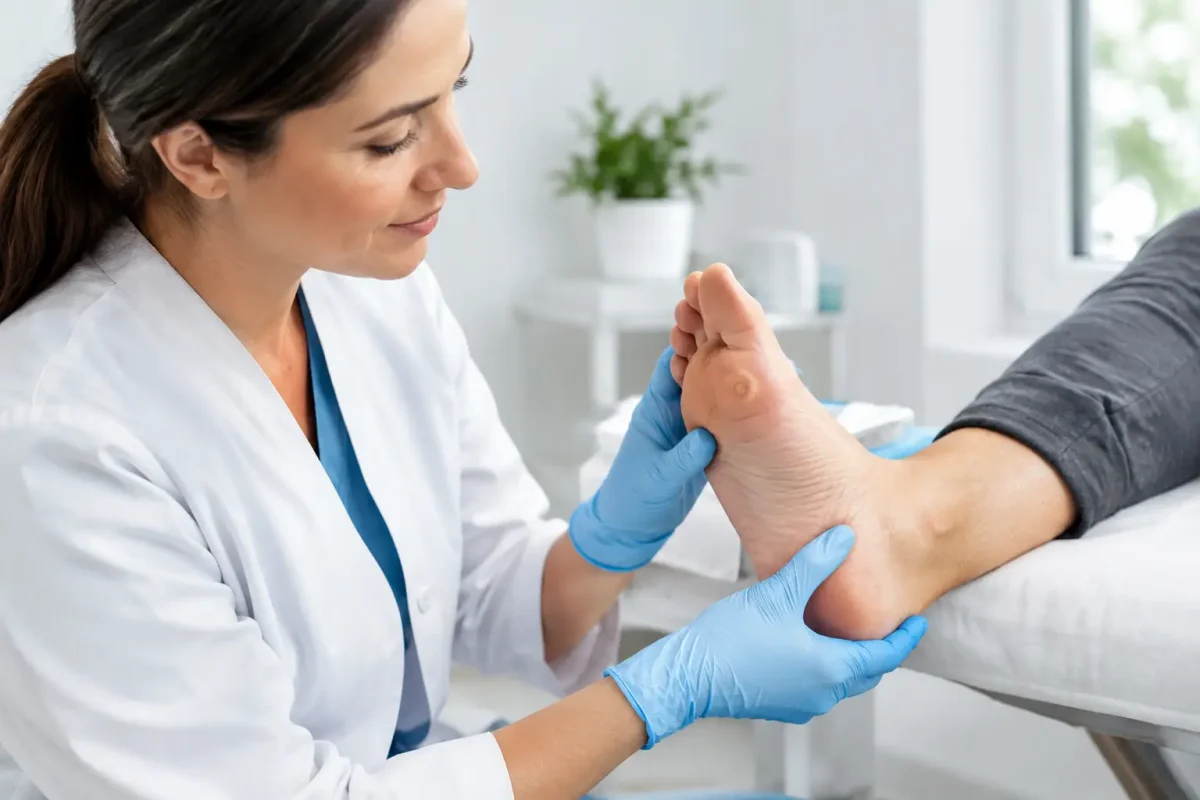
A corn can feel small enough to ignore until every step becomes a sharp reminder that something is wrong. Whether it is rubbing in work boots, flaring during a weekend run or making school shoes uncomfortable, this hard patch of skin can quickly limit how confidently you move. So, can podiatrists treat corns? Yes. A podiatrist can safely remove the corn, identify why it developed and help reduce the pressure that causes it to return.
Corns are common, but recurring pain is not something you need to simply put up with. The right treatment looks beyond the skin itself to how your footwear, foot shape, walking pattern and activity demands are affecting your feet.
Can podiatrists treat corns safely?
Podiatrists are trained to assess and treat corns using sterile instruments and techniques designed to protect the healthy skin underneath. During a consultation, your podiatrist will first confirm that the lesion is a corn and not another condition, such as a wart, callus, foreign body or skin issue requiring further medical review.
A corn is a concentrated area of hardened skin that forms in response to repeated pressure or friction. It often has a dense central core that presses into deeper tissue, which is why it can hurt when you stand, walk or wear closed shoes. Corns commonly develop on the tops and sides of toes, between toes, or on pressure points under the forefoot.
Professional treatment usually involves carefully reducing the hard skin and removing the central core where appropriate. Many people feel an immediate improvement in comfort because the direct pressure has been relieved. However, removal is only one part of effective care. If the force that created the corn remains, it may develop again.
Why corns keep coming back
Your skin is trying to protect itself. When a particular spot is exposed to repeated rubbing or loading, it thickens. The problem is that this protective response can become painful, especially when it forms a compact corn.
Tight, narrow or shallow footwear is a frequent contributor. Toes that are crowded together can rub against the inside of a shoe or against each other. High heels, firm dress shoes and poorly fitted safety footwear can all increase pressure in different areas of the foot. For active people, even a well-loved running shoe can become part of the problem once its cushioning and support have worn down.
Foot structure also matters. Bunions, hammer toes, claw toes, prominent joints, high arches and changes in foot alignment can create pressure points that ordinary shoes do not accommodate well. In some cases, the way your hips, knees, ankles and feet work together while walking may repeatedly overload one small area.
That is why a podiatry appointment should not end at simply removing hard skin. A thorough assessment considers your footwear, daily activity, occupational demands and lower-limb function. For someone who spends a shift standing on concrete, the solution may differ from that for a netball player or an older adult managing balance and mobility changes.
What happens during corn treatment?
Treatment begins with listening to what the corn is stopping you from doing. You may notice pain only in certain shoes, soreness after a long day at work, or discomfort when pushing off during sport. These details help guide the assessment.
Your podiatrist will inspect the affected area and surrounding skin, assess circulation and sensation where needed, and look at the shape and function of your feet. They may also assess your footwear and observe how you stand or walk. If a recurrent corn appears linked to altered loading through the foot and lower limb, further biomechanical assessment may be useful.
The corn can then be reduced with a sterile scalpel. This is generally a precise, conservative treatment, and it should not be confused with cutting a corn yourself at home. A podiatrist removes only the non-living hard skin, taking care around the healthy tissue beneath. Padding or offloading may be applied afterwards to reduce friction while the area settles.
For some people, a single treatment and better-fitting shoes are enough. For others, especially where toe shape or mechanics are involved, the plan may include cushioning, toe props, footwear modifications, orthotic support or a programme to improve lower-limb movement and load management.
Corns, calluses and warts are not the same
It is easy to mistake one for another, particularly when a painful spot sits under the ball of the foot. A callus is usually a broader, flatter area of thickened skin caused by friction or pressure. It may feel rough or dry but is not always painful.
A corn is more localised and often has a firm centre. It can feel like walking on a small stone, particularly if it is under the foot. Soft corns can develop between toes where moisture is trapped and skin rubs together.
Plantar warts are caused by a virus, rather than pressure alone. They may interrupt normal skin lines and can have tiny dark dots within them. Warts need a different treatment approach, so self-treating a suspicious lesion as a corn can delay the right care.
If you are unsure what you are dealing with, an assessment is the safer option. This is particularly true if the area bleeds, changes colour, ulcerates, becomes increasingly painful or does not respond as expected.
When not to use corn plasters or DIY cutting
Over-the-counter corn plasters often contain acids intended to dissolve hard skin. They can be useful for some people when used exactly as directed, but they do not correct the source of pressure and may irritate healthy surrounding skin. They are not suitable for everyone.
Avoid attempting to cut, shave or dig out a corn yourself. It is easy to remove too much skin, cause bleeding or introduce infection, especially when the corn is deep or located between toes.
Professional care is particularly important if you have diabetes, poor circulation, peripheral neuropathy, reduced sensation, a history of foot ulcers, immune system concerns or difficulty seeing and reaching your feet safely. In these situations, even a minor skin injury can become serious. A podiatrist can provide appropriate treatment and advise on a safe ongoing foot-care plan.
Preventing painful corns from returning
Prevention is about reducing the friction and pressure that triggered the corn in the first place. Shoes should have enough length, width and depth for your foot shape, particularly around the toes. A shoe that is comfortable when you first try it on should also remain comfortable after a full day of walking or standing.
Do not assume that a larger shoe alone will solve the issue. A shoe can be long enough but still too narrow, too shallow or poorly shaped for your toes. Socks also make a difference. Smooth, well-fitting socks can reduce rubbing, while worn or bunched socks can create extra friction.
If you have a recurring corn under the forefoot or beside a toe joint, pressure redistribution may be needed. This can involve targeted padding, footwear advice or custom orthotics designed around your individual foot posture, activity and symptoms. Where altered movement is contributing, a broader plan may include rehabilitation to improve strength, control and mobility through the foot and lower limb.
At Comfort Feet Podiatry Group, corn treatment can be paired with a hands-on assessment of the factors affecting your movement, rather than treating the painful spot in isolation. That approach is especially valuable when pain is interfering with work, training, family activities or your confidence on your feet.
When to book a podiatry appointment
Book an assessment if a corn is painful, keeps returning, affects your walking or makes footwear difficult to tolerate. You should also seek prompt advice if there is redness, swelling, discharge, broken skin or signs of infection.
Do not wait for a small pressure point to change the way you walk. Compensating for foot pain can place extra stress on the ankle, knee, hip or back, particularly when you are active or spend long hours standing. Getting the right diagnosis and pressure-relief plan early can help you stay comfortable, mobile and ready for the things your day demands.
Your feet carry you through every shift, school run, training session and walk around the neighbourhood. If a corn is making those ordinary movements painful, professional treatment can help you move freely again and give your skin a better chance to stay that way.